No products
Prices are tax included
-
SOLUTIONS
-
-
BUY
-
-
THIN INSULATION
-
R'BULL pro 13 | Thin Reflective Insulation...
14 Review(s)337,58 € 450,10 € -25%Delivered to your home* price: ◉ Europe...
À prix réduit!Delivered to your door free of charge -
R'BULL pro 13 | Thin Reflective Insulation...
1 Review(s)333,09 € 444,12 € -25%Rate delivered to your home* : ◉ Europe...
À prix réduit!Delivered to your door free of charge -
R'BULL pro 5 | Thin Reflective Insulation...
3 Review(s)421,05 € 561,40 € -25%Rate delivered to your home* : ◉ Standard...
À prix réduit!Delivered to your door free of charge -
R'BULL pro 5s | 5mm floating parquet...
3 Review(s)296,24 € 370,30 € -20%Rate delivered to your home* : ◉ Standard...
À prix réduit!Delivered to your door free of charge -
Aluminium adhesive tape 75 mm x 50 m....
2 Review(s)26,00 €Rate delivered to your home* : ◉ Europe stock...
In stock -
R'Acoustic 20 | Thin Acoustic Thermal...
5 Review(s)234,43 € 275,80 € -15%Rate delivered to your home* : ◉ Standard...
À prix réduit!Delivered to your door free of charge -
R'Acoustic 10 | Thin Acoustic Thermal...
3 Review(s)200,52 € 235,90 € -15%Rate delivered to your home* : ◉ Standard...
À prix réduit!Delivered to your door free of charge -
R'Acoustic Alu | Insolant Mince Réflecteur...
2 Review(s)251,77 € 296,20 € -15%Rate delivered to your home* : ◉ Europe...
À prix réduit!Delivered to your door free of charge -
R'BULL pro 5 | Thin Reflective Insulation...
1 Review(s)202,50 € 270,00 € -25%Rate delivered to your home* : ◉ Standard...
À prix réduit!Delivered to your door free of charge -
R'Flam Pro 6 | Thin Reflective Insulation...
2 Review(s)497,03 € 662,70 € -25%Home delivery price* : 1 Roll : 19.88 €/m²...
À prix réduit!Delivered to your door free of charge -
R'Flam Tape - Non-combustible aluminum...
23,46 €Flame-retardant aluminium adhesive roll for thin...
In stock
-
-
-
-
Heating panels
-
Fire-retardant heating film for radiant...
4 Review(s)70,20 €Rate delivered to your home* : ◉ Europe...
En Stock -
Fire-retardant heating film for radiant...
51,48 €Rate delivered to your home* : ◉ Europe...
En Stock -
eFilm Power - Width 60 cm
1 Review(s)59,84 €Heating film for specific applications 25-year...
In stock -
-
-
Cassette radiant great heights :...
498,30 €The radiant heating CRIR 1800 is intended for the heating...
En Stock
-
-
Thermostats
-
Connected programmable thermostat for...
9 Review(s)113,04 €Rate delivered to your home* : ◉ Stock France...
STOCK FRANCE: In stock for delivery within 24/48 hours with tracking. -
Connected programmable thermostat for...
2 Review(s)120,24 €Rate delivered to your home* : ◉ Stock France...
STOCK FRANCE: In stock for delivery within 24/48 hours with tracking. -
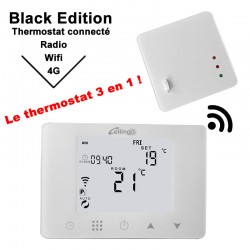
Radio-connected, programmable 4G wifi...
149,76 €Connected radio thermostat . Programmable device...
STOCK FRANCE: In stock for delivery within 24/48 hours with tracking. -
Floor probe for radiant floor heating...
20,00 €Rate delivered to your home* : ◉ Express...
In stock for delivery within 24/48 hours (France stock)
-
-
-
-
Heated mirrors / Connected furniture
-
Mirolia Pro series. Self-adhesive heating...
3 Review(s)110,88 €No more fogging up your mirror! Mirolia eliminates...
STOCK FRANCE: In stock for delivery within 24/48 hours with tracking. -
Custom-made heated mirror
2 Review(s)59,40 € 66,00 € -10%We create the heated mirror of your dreams 2 options...
À prix réduit!In stock -
Mirolia Carbon Pro series. Self-adhesive...
100,84 € 112,04 € -10%Turn your mirror into a heated mirror. Freedom...
À prix réduit!In stock -
MIROLIA PANEL DECO
1 Review(s)1 020,00 € 1 360,00 € -25%Mirolia Panel Deco is a decorative heated mirror with...
À prix réduit!En Stock -
-
Hot Table, musical back-lit
6 312,24 €Table immersive to animate your evenings with your...
In stock -
-
-
Switch
-
Magic Switch, the switch is invisible...
1 Review(s)115,68 €Advantages : Removes the risk of...
Available
-
-
-
-
Payment in 4 instalments, interest free

-
Connectors
-
Lever terminals 2 conductors in line -...
1 Review(s)21,90 €Price delivered to your door* : Set of 50...
In stock for delivery within 3 days (France stock) -
Flexible cable with grounding connector...
10,77 € 11,34 € -5%Earth connection of our aluminum insulators for the...
À prix réduit!In stock for delivery within 3 days (France stock)
-
-
Fasteners
-
Clips + screws for fastening ceilingo...
57,90 €*Metropolitan France and Belgium only.
In stock for delivery within 3 days (France stock) -
Set of 100 5 x 50 mm flat-head screws +...
50,00 €Ideal for creating an air gap and limiting contact points...
In stock for delivery within 3 days (France stock)
-
-
Services
-
Complimentary telephone technical support,...
60,00 €The purchase of our products we undertake, which is why...
Service included
-
-
-
-
Understand
-
-
CONTACT
-








Heat, temperature, perception and thermal comfort
Published:
09/14/2018 19:26:03
Categories:
Installer training
, Radiant heating and cooling ceilings
Heat and temperature
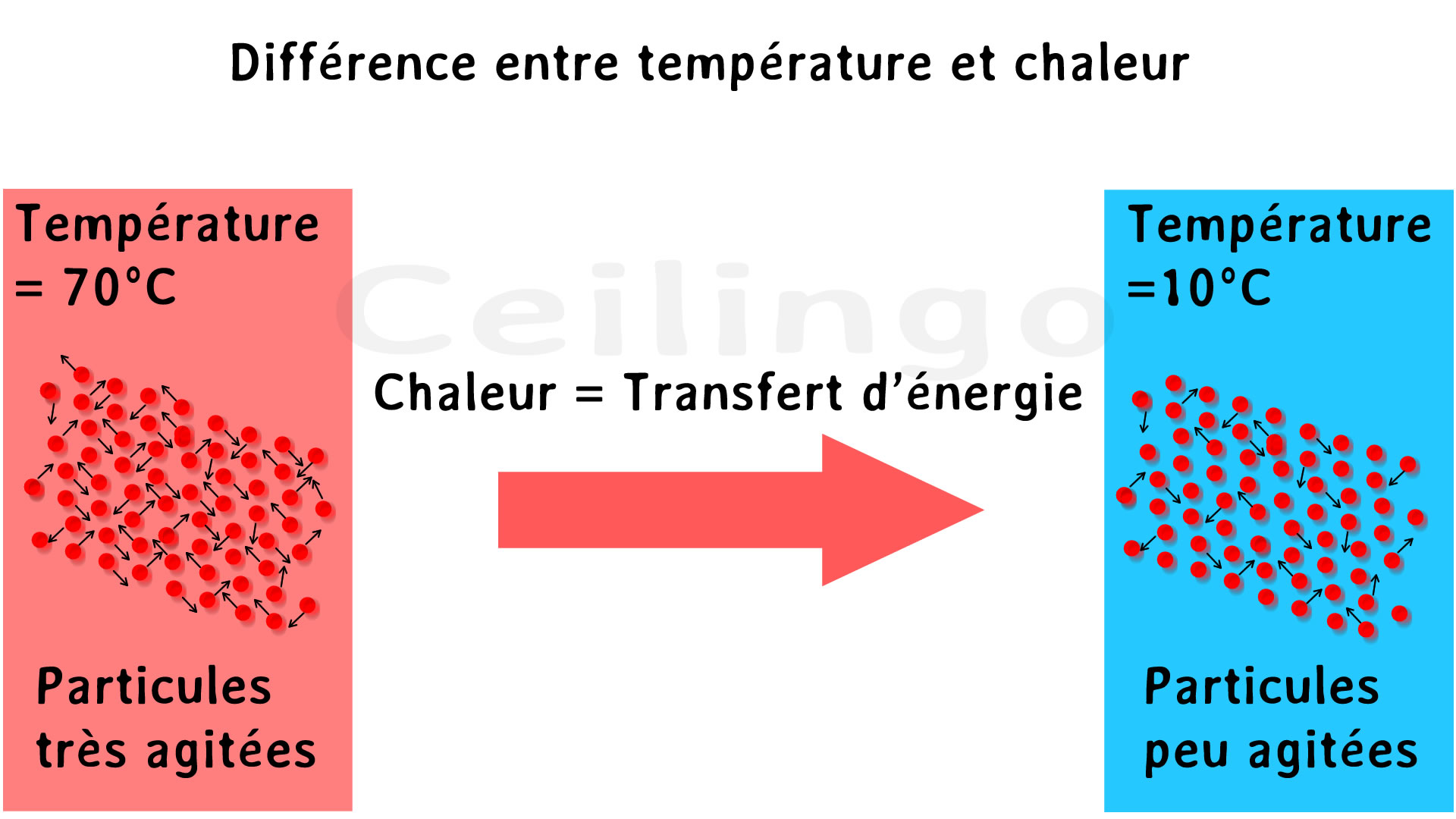
Heat is a form of energy that transfers between two bodies at different temperatures, and it always travels from the warmer body to the cooler one.
Heat is the transfer of energy from one object to another. It is the energy of the movement of the particles in an object.
Temperature is the measure of how hot a body is. It measures how agitated the atomic particles within the material are. The faster those atoms or molecules move, the higher the temperature.
What mass means here
Mass is the quantity of atoms contained in the material.
The more molecules an object contains, the more thermal energy it holds.
The higher the temperature of an object, the more thermal energy it holds.
And the reverse in both cases.
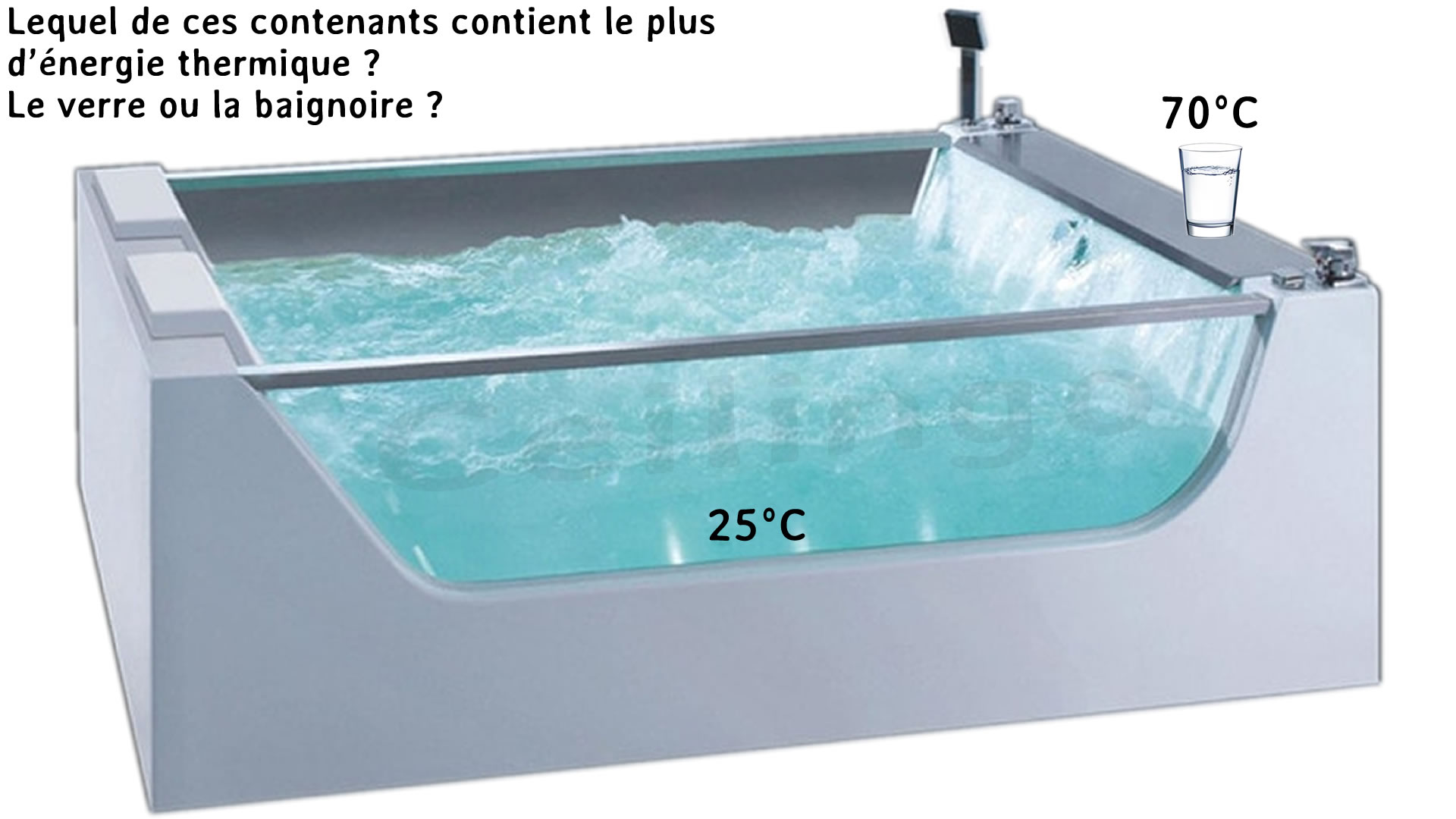
Take a glass of water at 70 °C and a bath filled with water at 25 °C. Which quantity of water holds the most thermal energy?
The temperature is far higher in the glass, but the glass contains far fewer molecules. The thermal energy is therefore lower in the glass than in the bath, even though the bath is at a lower temperature.
An example
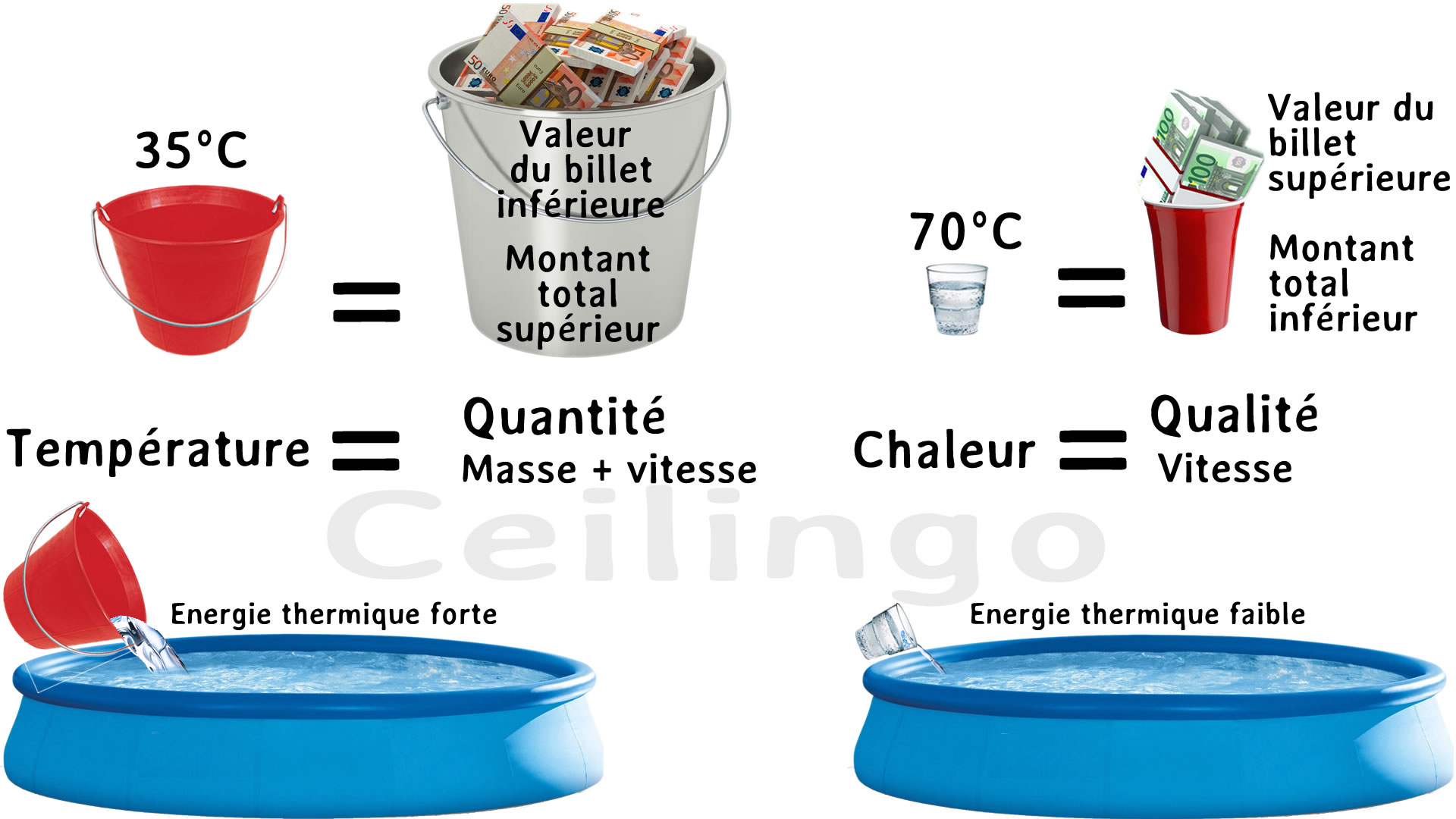
Now suppose we want to warm a swimming pool using a bucket of water at 35 °C, and another pool using a glass of very hot water at 70 °C.
Replace the water molecules with banknotes:
a bucket filled with 50 euro notes and a glass filled with 100 euro notes.
The total amount in the bucket is far greater than the total in the glass.
In the glass, the quality of the hot water, like the value of each note, is higher.
In the bucket, the quantity of hot water, like the number of notes, is greater.
It is the speed of the molecules that determines the quality of what is hot. That quality depends only on their speed and has nothing to do with their total mass.
Even though the water molecules in the bucket move more slowly, there are far more of them. What they lack in speed they make up in number. The quantity of what is hot depends on both mass and speed.
The great difference between temperature and heat is that temperature depends on speed alone, whereas heat depends on both speed and mass.
Quality of what is hot = temperature = speed
Quantity of what is hot = heat = speed + mass
The water in the glass is at a very high temperature but holds very little heat. The water in the bucket is at a much lower temperature but holds a great deal more heat.
In conclusion, a bucket of water at 35 °C warms a swimming pool more effectively than a glass of water at 70 °C.Quantity at a lower temperature beats quality at a higher one.
Thermal energy
Thermal energy depends on the mass of a body and on how agitated the particles within it are.
Thermal energy = mass + temperature
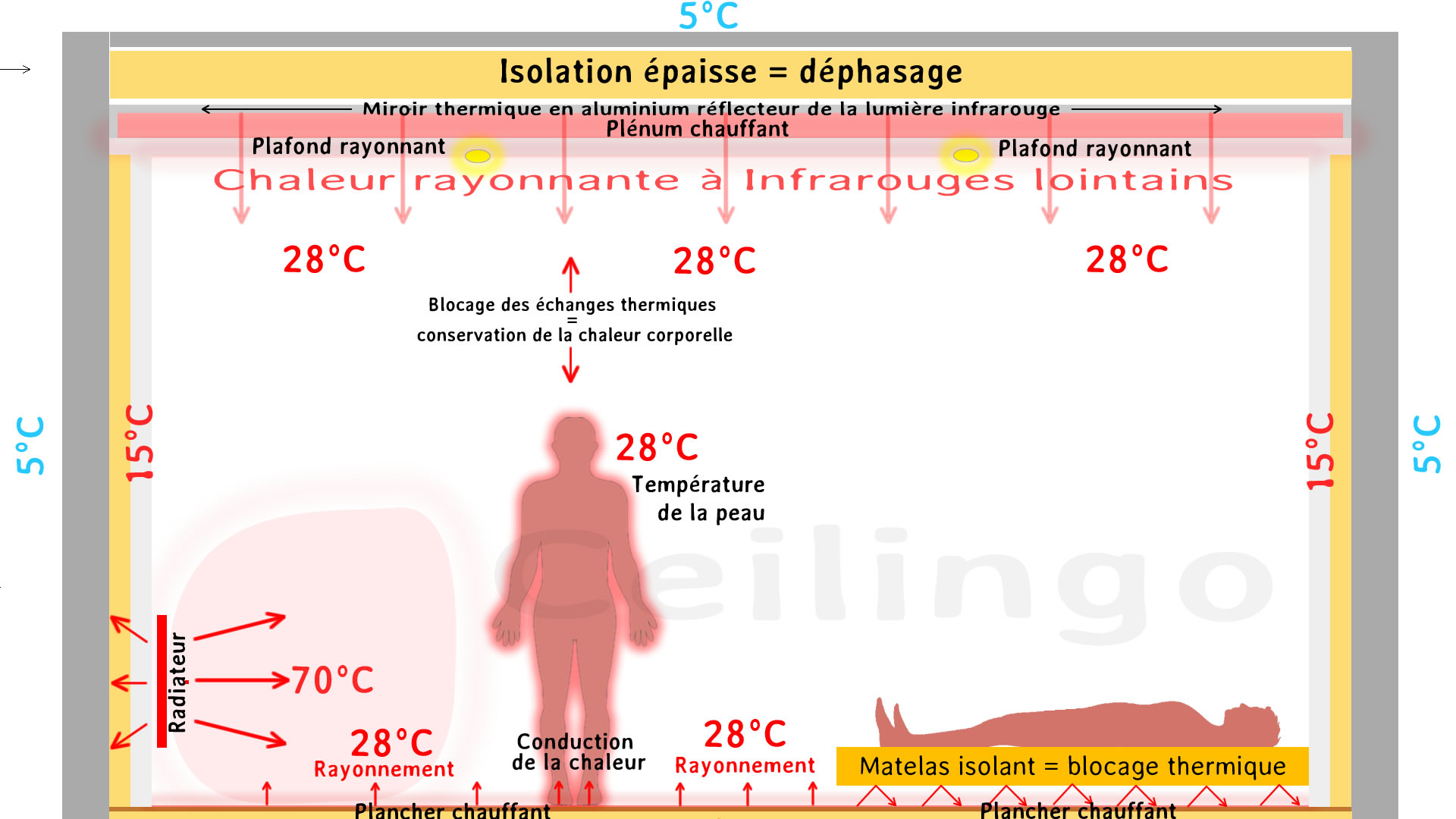
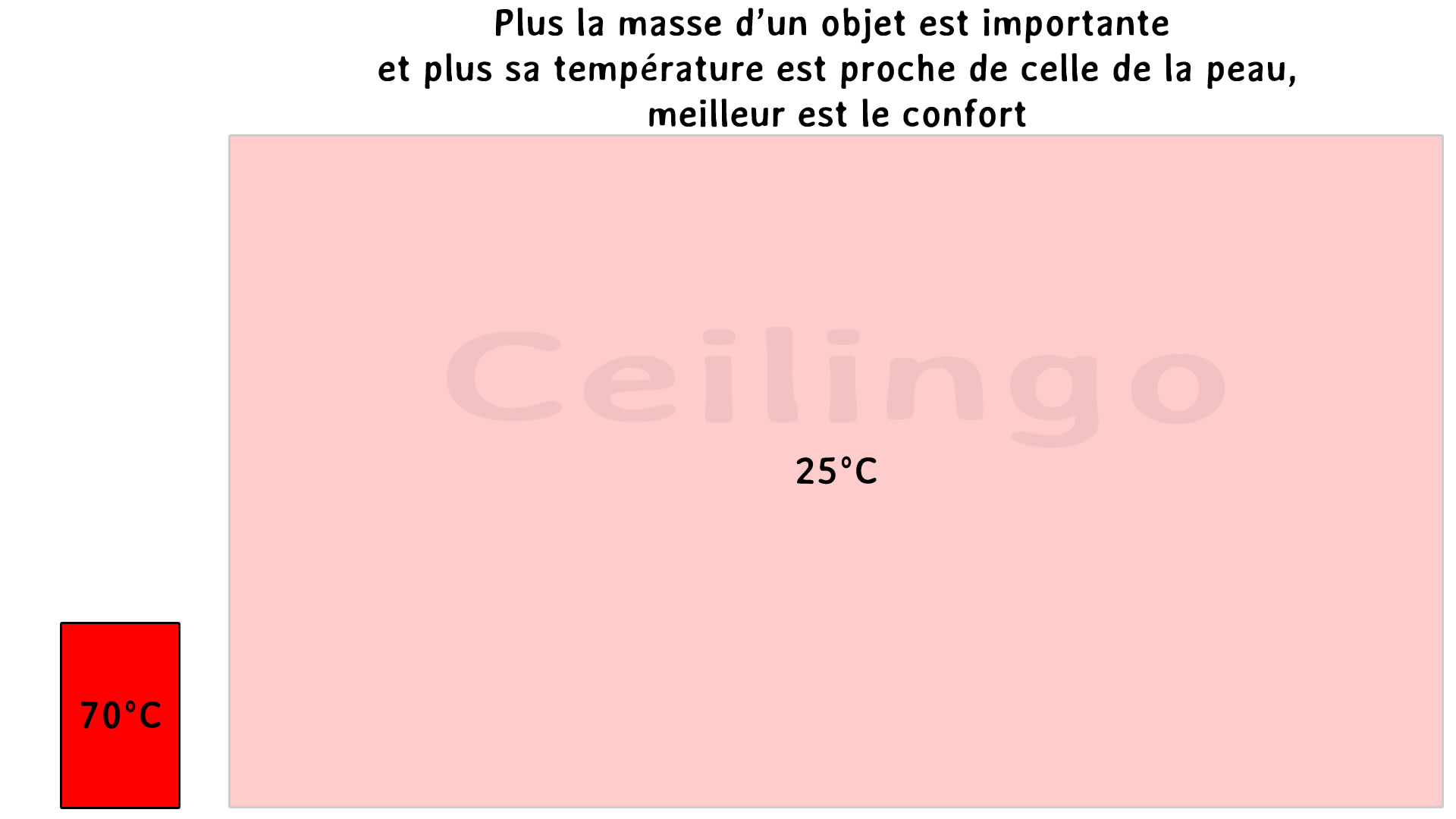
A body at 25 °C with a heat exchange surface forty times greater than that of a hot body at 70 °C holds considerably more thermal energy.
That greater mass combined with temperatures that stay low, close to that of the skin, is what we call thermal comfort.
What we actually feel
What we feel is the link between the idea of heat and the idea of temperature.
Here is a short experiment to show it.
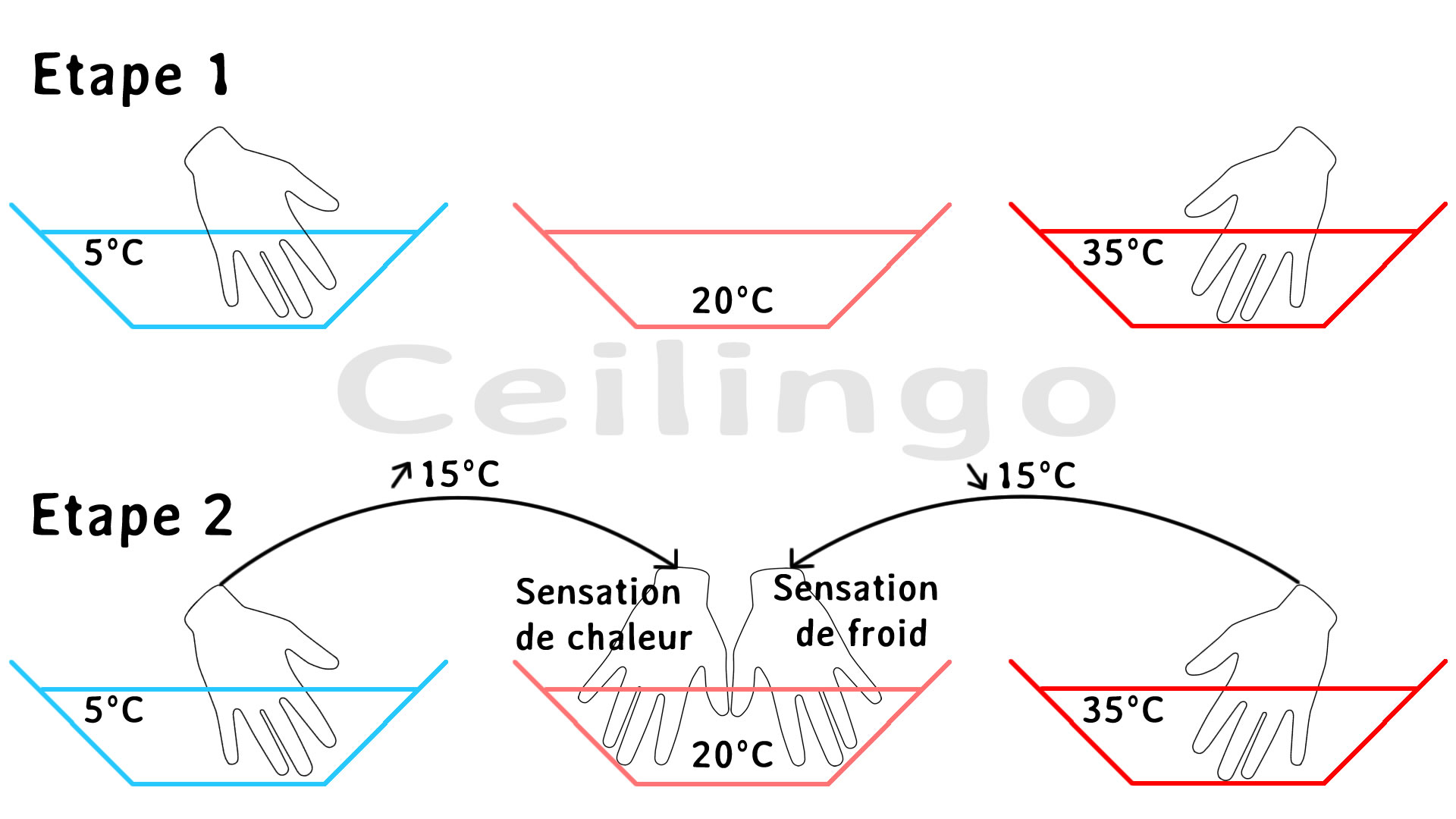
Take three containers of equal volume, each at a different temperature.
Put your left hand in the one at 5 °C and your right hand in the one at 35 °C, for thirty seconds.
Then take both hands out and put them into the middle container, whose water is at 20 °C.
What will you feel?
Your left hand will register a sensation of warmth, while your right hand registers a sensation of cold. And yet the container is at 20 °C for both hands.
Which shows that what we feel is a genuine sensation that is nonetheless wrong in thermal terms, and that heat and temperature are two different things.
Thermal comfort
Thermal comfort is a close relationship between the mass of a body and its temperature.
A radiant ceiling offers the largest possible surface for heat exchange at the lowest possible temperature.
That match between area and working temperature, together with the absence of any obstacle to the spread of that energy, is what makes a radiant ceiling the most effective form of heating of those available.
It puts to work the same principles that govern the effect of sunlight, which is where our idea of comfort comes from in the first place.